• Skip to primary navigation
  • Skip to main content
Discovery Isle
  • About Us
    • History
    • Locations
    • Private Preschool Advantage
    • Health & Safety
    • Blog
  • Preschool
    • Overview
    • Our Curriculum
    • Family Communication
    • Infants
    • Toddlers
    • Beginners (2-3 yrs)
    • Intermediates (3-4 yrs)
    • Pre-K
  • Camp & After School
    • Summer Camp
    • Before & After School
Contact Us
 
  • About Us
    • History
    • Locations
    • Private Preschool Advantage
    • Health & Safety
    • Blog
  • Preschool
    • Overview
    • Our Curriculum
    • Family Communication
    • Infants
    • Toddlers
    • Beginners (2-3 yrs)
    • Intermediates (3-4 yrs)
    • Pre-K
  • Camp & After School
    • Summer Camp
    • Before & After School
Contact Us

esemans

Little Social Butterflies: Tips for Raising a Socially Savvy Preschooler

We all want our children to grow up happy, healthy, and thriving – and building strong social skills is a key part in achieving this. At our preschool, we recognize that sharing, making friends, and problem-solving are crucial components for a child’s overall development. That’s why our Links to Learning curriculum is focused on building these skills! 

In our classrooms, we strive to incorporate social interactions into every aspect of our students’ schedule and routines. Our teachers implement a variety of techniques, such as using emotion charts to showcase different feelings, displaying photo prompts throughout the classroom to encourage sharing, and facilitating games that require taking turns. Additionally, our teachers serve as role models, demonstrating gratitude and socially appropriate behaviors throughout the school day.

Building strong social skills is an ongoing process that extends beyond the classroom. To help you continue building these skills at home, we’ve put together five simple and fun activities.

1. Encourage purposeful play

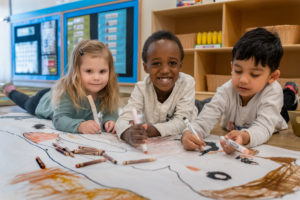
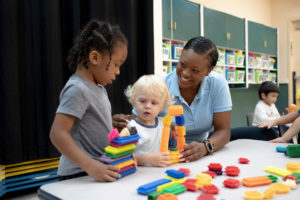
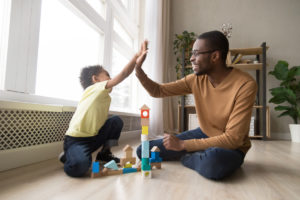
Purposeful play is an excellent opportunity to boost your child’s social skills. Encourage them to work on activities with you that involve teamwork and communication, such as building towers with blocks, working on a puzzle, or making crafts together. Not only will your child develop important problem-solving skills, but their creativity and imagination will also flourish through playtime. 

2. Model sharing behavior

Children learn from the behaviors of the adults around them. You can model sharing by offering your child a piece of your snack or sharing a toy with them. Use positive language to describe the behavior, such as “It’s so fun to share my snack with you” or “Sharing makes me feel happy.” When your child sees your actions, they are more likely to follow suit and learn to share with others. 

3. Introduce the concept of a “worry can”

A “worry can” is a helpful visual tool that can help build your child’s communication skills by encouraging them to express their fears in a positive way. Decorate a special can together, then ask your child to write or draw their worries on a piece of paper and place them in the can. Together, have an open and honest conversation about their worries and help them problem-solve any issues they may have.

4. Roleplay different social situations

Roleplaying is a great way to address specific issues, such as shyness or difficulty making friends. By practicing social skills in a safe environment, children can become more comfortable and confident in different situations. To get started, introduce yourself to your child and ask them to do the same. Encourage them to say their name, age, and something they like. Provide positive feedback to boost their confidence.

5. Read books about emotions

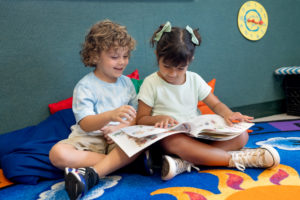
Books can help your child learn to identify and express their feelings, recognize emotions of others, and manage emotions (i.e., deep breathing or counting to 10). While reading, discuss how the characters feel and ask your child how they would feel in a similar situation. Some of our favorite books include The Color Monster by Anna Llenas, The Way I Feel by Jenan Cain, and Big Feelings by Alexandra Penfold. 

Celebrating the Joy of Learning with Week of the Young Child 

April 1-7 is Week of the Young Child, which recognizes young students, their teachers, and their families for all their hard work. This annual event, sponsored by The National Association for the Education of Young Children (NAEYC), allows us to showcase the importance of early childhood education, our Links to Learning curriculum, and everyone who makes it possible.

Below is how we’re celebrating each day in our classrooms. 

Music Monday

Our Week of the Young Child celebrations kick off with Music Monday. Through singing, dancing, and listening to music, our students develop language and literacy skills, self-expression, and creativity. Our teachers provide musical instruments and encourage students to practice following along to music of various tempos.

Tasty Tuesday

On Tasty Tuesday, we’re connecting literacy skills with math and science, while also encouraging healthy nutrition habits. By engaging in hands-on cooking activities, our students also develop their fine motor skills, hand-eye coordination, and cognitive abilities such as following instructions. They scoop and pour ingredients, assist in measuring, taste their cooking creations, and chart their favorites. Bon appétit!

Work Together Wednesday

Work Together Wednesday is all about emphasizing the importance of building and maintaining a positive classroom community and culture. When our students work together, they explore important academic concepts while also building their social-emotional skills like sharing and problem solving. They learn to take turns and share their ideas as they play board games, contribute to class murals, and build towers together.

Artsy Thursday

Ready, set, create! Through open-ended art activities using paint, clay, crayons and more, students use their imagination, develop fine motor skills, and gain a sense of achievement and pride. In our classrooms, teachers inspire students as they learn about various artists and types of art. Teachers focus on process-based art education, so that the experience of creating is valued beyond that of the end product.

Family Friday

On the last day of Week of the Young Child, we’re celebrating our students and their families. We partner with families throughout the year to learn about their backgrounds and traditions, and then provide books and other materials that highlight their cultures in authentic ways. Students share their celebrations and learn that all families have unique characteristics. 

The World is Evolving and So Has Our Curriculum

Our goal has always been to provide a learning environment that fosters curiosity and creativity and prepares children for kindergarten and beyond. We evaluate our proprietary curriculum, Links to Learning, regularly to ensure that we continue delivering the program students need.

We know that the world is constantly evolving, and the skills children need today are different from what they were even a few years ago. Because of this, we’ve made the following important enhancements to our curriculum. 

Children have more opportunities to practice social-emotional skills.

Social-emotional learning has always been a hallmark of our curriculum, as these skills are just as important as foundational academic skills. We want our students to be happy, thriving, and making friends. Due to the impact of the COVID-19 pandemic, we’ve added even more hands-on activities for children to practice setting goals, problem solving, developing self-confidence, and sharing. As always, our teachers help children by modeling appropriate behaviors, giving effective praise, and providing verbal and visual cues.

Children participate in more hands-on activities to provoke questions and attitudes about themselves and others.

When children feel emotionally and physically safe, they are more likely to take on challenges and be more comfortable in their learning. We’ve always been steadfast in our commitment to designing classrooms and teaching strategies that support diversity, inclusion, and belonging. We’ve added more items to help facilitate that learning, such as dolls with various skin tones, puzzles and games depicting various cultures, musical instruments from other countries, and culturally diverse dramatic play props.

We’ve enhanced skills throughout all subject areas to further prepare children for elementary school and beyond.

We’ve integrated more opportunities during the day for your child to strengthen the muscles needed for writing across various subject areas. This includes activities to exercise fine motor skills and hand-eye coordination using safety scissors, tweezers, tongs, and paint brushes. We’ve also adapted a spiralized approach to our Spanish curriculum, meaning that teachers will introduce new vocabulary while reviewing the vocabulary learned in younger classrooms. Children have opportunities to practice Spanish during transitions, centers, and even in outdoor learning experiences.

We’ve updated our family communication pieces.

We place a premium on making sure our families know what skills their child is working on, how they’re progressing, and what they’re loving most. We’ve included a QR code in our End of the Month folders so families can see digitally all the skills and goals their child achieved that month. Continuing the learning at home is now even easier with our refreshed Baby Sign Language poster, Spanish posters, and activity letters. Our Links 2 Home app and Family Reports have also been updated to give teachers space to showcase how each child is practicing social-emotional skills and the progress they are making.

Exploring Valentine’s Day at School and at Home

Valentine’s Day is a favorite holiday among our students. They love exchanging cards and treats with their classmates and participating in all the themed activities we plan throughout the month. 

Activities include learning about different types of flowers typically given for the holiday, how to care for them, and where they are grown. Students also learn about the postal service and practice their writing skills by making and mailing cards. We also integrate conversations and books about kindness, friendship, and family throughout our day. Below are four activities to continue the learning and fun at home with your little one. 

Sink the Candy Heart Boat

For this fun sink vs. float experiment, you’ll need a bucket or tray filled with water, candy conversation hearts, and lightweight plastic containers. Place the containers in the water and ask your child to guess how many candy conversation hearts will sink the container. Encourage your child to count as they fill the container one candy heart at a time. They may find that the container sinks faster depending on where the candy hearts are placed!

Sponge Painting

Create colorful heart prints using sponges and paint. Cut heart shapes out of sponges and provide them to your child along with pink, white, and red paint. Ask them to pick up the sponge, dip it into the paint, and press it onto paper to create festive prints. This is a great project to foster creativity and to practice fine motor skills. Encourage older children to use the prints to create Valentine’s Day cards for family or friends.

Indoor Heart Hopscotch

Put your child’s balance and gross motor skills to the test by playing a fun game of hopscotch. Gather markers, 10 pieces of construction paper, and painter’s tape. Draw a large heart on each piece of paper, add a number from 1-10 inside each heart, and tape it to the floor to create a hopscotch board. You can make the game as easy or difficult as you’d like. Some ideas include asking your child to say the numbers aloud as they hop, jumping over specific numbers, or encouraging them to create their own game.

Valentine’s Day Books

Valentine’s Day is a perfect time to reinforce themes of love, kindness, friendship, and acceptance through books. Some of our favorites include, Llama Llama I Love You by Anna Dewdney, The Day It Rained Hearts by Felicia Bond, The Night Before Valentine’s Day by Natasha Wing, and Little Blue Truck’s Valentine by Alice Schertle. 

What Scientific Exploration Looks Like in Our Preschool Classrooms

Soda bottle geysers and volcanoes made from baking soda and vinegar might be just some of the things that come to mind when you think about science education for young children. It’s important to note that even simpler activities and everyday experiences can introduce children to scientific concepts and help them gain an understanding of how things work. 

Science also helps children to develop important life skills, such as communication, collaboration, perseverance, analytical reasoning, and most importantly, a sense of wonder. We believe science education is critical in the preschool years, and we do so by tapping into children’s natural curiosities to explore the world around them.

Below are ways we foster this in each of our classrooms.

Toddlers (1-2 years) 

The Scientific Exploration component of our curriculum begins in our Toddler classroom. Teachers provide toys and materials that allow toddlers to experiment with cause and effect, such as buttons that push to make a sound, knobs that twist to open, and levers that slide open to make an object appear.

Beginners (2-3 years)

Our Beginner students begin to explore engineering concepts. They design and build small structures using various materials, such as toothpicks and playdough or craft sticks and small paper cups. As students design and build, teachers ask open-ended prompts, including, “Tell me about what you made” or “What are you going to do with your new structure?”

Intermediates (3-4 years)

While our Intermediate students are engaged in science activities, teachers offer a variety of tools and technology to support and enrich the learning. For example, when learning about living things, they may explore with magnifying glasses, paper, and writing utensils. While studying the Earth’s environment, students may use balances, thermometers, rain gauges, and sifters. 

Pre-K (4-5 years)

Students in our Pre-K classrooms love learning about different animals and their life cycles. After reading related books, students use playdough, paper, and writing utensils to create a 3-D representation of the life cycle of their choosing. They label the different stages and share their unique models with their classmates. Afterward, they write about the life cycle in their science journal.

Social-Emotional Learning from Infancy through Pre-K

Social-emotional skills acquired in the preschool years pave the way for children to form lasting friendships, develop empathy, and understand different situations. Our teachers encourage social-emotional development, first and foremost, by creating a safe and supportive environment where every child feels good about coming to school.

Below are specific examples on how we facilitate this learning in each of our classrooms. 

Infants (0-1 year)

Positive verbal, nonverbal, and physical interactions provide infants with a sense of safety, confidence, and self-worth. Our teachers design activities that allow infants to look to them for support and encouragement when exploring new materials. For example, if an infant is struggling to fit a shape into the shape sorter, our teachers assist and prompt the infant by saying, “Let us try and turn the piece this way” or “I don’t think that shape fits. Should we see if it fits in another spot?” 

Toddlers (1-2 years)

In our toddler classroom, students take an active part in dressing themselves. For example, teachers may ask, “Can you pull your arm through the sleeve,” or “Please take your socks off for our sensory walk.” Teachers also expose toddlers to a variety of emotions in developmentally appropriate ways. They may show pictures of children making various facial expressions and encourage the toddlers to practice identifying the emotions and mimicking the expressions in a mirror.

Beginners (2-3 years)

Our Beginner teachers support sharing and taking turns by providing students with visual prompts and auditory cues. For example, if they notice a student has been waiting to play with maracas, they may say, “Sophie, what special words could you use to have a turn with the maracas?” To make children feel safe and welcome when entering the classroom, teachers include the individual student’s name in the greeting and demonstrate gratitude when they return the greeting. Sometimes they may even greet students with a high-five, fist bump, or happy dance.

Intermediates (3-4 years)

Intermediate teachers encourage students to generate some of their own rules and routines, even silly ones! This promotes ownership over their own behaviors and allows students to feel respected within the classroom community. Teachers also provide students with words to describe why they feel a particular way if they can’t express it themselves. They may say, “I think you’re angry because your face is red and you yelled. I would be angry too if someone took my toy.” They then guide students through brief exercises to help self-calm and reduce stress, such as taking slow, deep breaths. 

Pre-K (4-5 years)

Teachers in our Pre-K classroom inspire students to plan and engage in challenging tasks by modeling correct methods, techniques, and goals. Examples of this include using blocks to create a ramp for cars or assisting in searching for letters in a sensory bin to spell sight words. Our teachers always praise students for their effort with specific feedback. During centers, students direct their learning with supervision from their teachers, which creates opportunities to initiate and solve their own problems. 

How Our Literacy-Rich Classrooms Foster a Love of Learning

Our teachers inspire a love of reading and language every day by creating a child-centered, literacy-rich environment where stories, letters, and words are consistently introduced to students. In our classrooms, materials are labeled with photographs and words, vocabulary development is paramount, and children’s writing attempts are apparent. 

Below are a few ways we introduce language and literacy in each of our programs. 

Infants (0-1 year)

Language and literacy education begins with our youngest learners. Our teachers establish this foundation with our infants by looking at picture books, reenacting stories using puppets, and reciting nursery rhymes. Teachers take the learning outdoors by encouraging infants to explore sounds heard. For example, teachers may ask, “Do you hear a bird chirping?” or “Do you hear the leaves crunching while we walk?” Through these activities, infants learn about the sounds and structure of language, pre-literacy skills that influence their later success in reading, writing, and speaking.

Toddlers (1-2 years) 

Toddler teachers turn reading books into an interactive experience by using dialogic reading. In dialogic reading, teachers engage the students as storytellers and ask questions about the story. For example, the teacher may point to a dog in the book and say, “What is this?” The student may respond, “Dog,” and the teacher will further the conversation by saying, “Yes! That’s a brown dog. Can you say brown dog?” 

Beginners (2-3 years)

Teachers in our Beginner classroom design learning experiences that provide students opportunities to recognize their first name in print. For example, they may place students’ first names in the sensory bin with other sensory materials and encourage students to find their name. Our classroom management systems are another way Beginner students learn to recognize their first name in print. Students place their picture, labeled with their first name, by the center they wish to explore.

Intermediates (3-4 years)

As opposed to teaching one letter per week, our teachers discuss letter names and provide opportunities for students to hear specific letter sounds. Prior to reading the book Strega Nona, the teacher may ask, “What letter makes the /s/ sound? What letter makes the /t/ sound? Let’s see if we can hear other words that sound like /s/ and /t/!” While reading, teachers also assist students in connecting new information to what they already know by saying, “This looks almost the same as _____” or “Have you ever _____?”

Pre-K (4-5 years)

Our Pre-K teachers incorporate many activities throughout the day for students to practice language and communication skills. During group discussions, teachers provide time for students to process what they hear and to share their individual thoughts. While exploring centers, teachers ask open-ended questions to encourage multiple responses. For example, they may say, “What would happen if ____” or “What else could you do here?”  Teachers create meaningful and authentic language experiences by encouraging students to read together to find answers, create labels, and write lists and thank you cards.

What Diversity, Inclusion, and Belonging Looks Like in Our Classrooms

Children learn best, develop self-confidence, and thrive when they feel valued and supported. Because of this, diversity, inclusion, and belonging are hallmarks of our school community. Our teachers strive to cultivate learning environments that foster respect and acceptance and encourage students to learn from and with each other.

Our classrooms contain a range of materials to provoke children’s questions, ideas, and attitudes about their own identities and about differences and similarities among others. Items in our classrooms highlight each student’s culture in a positive way and include rich literature that holistically reflect the students in the classroom community and showcase diverse family structures, dolls with various skin tones, a variety of art and musical instruments from other countries, music in multiple genres and languages, and culturally diverse dramatic play props.

Below are some specific examples of what diversity, inclusion, and belonging looks like in each of our classrooms.

Infants (0-1 year)

A common activity in our Infant classroom is looking at similarities and differences in front of a mirror. For example, the teacher may say, “Liam, you have big brown eyes! Let’s look at Zoey’s reflection. Look! She has big green eyes!” Teachers may also adhere pictures of the children’s families to the mirror and talk about the photographs while viewing the reflections in the mirror. 

Toddlers (1-2 years) 

In our Toddler classrooms, we listen to songs that celebrate diversity, such as “Dance Tunes from Many Lands” by Ella Jenkins. Teachers provide multicultural instruments (maracas, drums, rain sticks, chimes), ribbons, and scarves, and encourage the children to dance along to the music while discussing the different rhythms, tempos, and lyrics.

Beginners (2-3 years)

We ask our Beginner students to bring in props from home that relate to personal experiences, such as empty food containers they enjoy sharing with their family or pieces of clothing that represent their family’s heritage. Teachers place these props in the dramatic play center for students to use while sharing and interacting with their peers.

Intermediates (3-4 years)

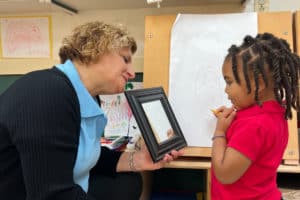
Intermediate teachers encourage students to bring in family photos. Teachers cut the portraits into interconnecting pieces varying in size and amount, meeting the needs of the individual students. All the puzzles are placed in the manipulative center for independent student exploration. This activity incorporates diversity, inclusion, and belonging, while also reinforcing mathematical skills of problem-solving and reasoning.  

Pre-K (4-5 years)

In our Pre-K classrooms, we ask students to bring in pictures of a special family celebration, meal, or tradition. Students glue their picture to a piece of paper and are encouraged to discuss the photo and write or draw about the photo underneath. Teachers collect all the pictures to create a classroom book titled, “Our Family Memories.”  

At-Home Math Activities for Infants through Pre-K

Everyday experiences are packed with mathematical concepts that fascinate and challenge children and help them to make sense of their world. Even the youngest infants can begin to foster their math skills by listening to stories that involve counting and repetition. 

In our classrooms, students learn the foundations of addition, subtraction, and geometry by sorting objects by color and shape or by graphing weather patterns. Below are a few easy, age-appropriate activities to continue the learning at home. 

Infants (0-1 year)

Books are a great way to introduce your child to numbers while also boosting their literacy skills. Some of our favorite titles include, Counting Kisses by Karen Katz, Ten, Nine, Eight by Molly Bang, More, More, More Said the Baby by Vera B. Williams, and Black and White by Tana Hoban.

Toddlers (1-2 years) 

Find empty containers of various sizes around your home. Provide your child with dry pasta or rice and create a pouring station where they can practice filling and dumping the containers. Narrate their actions and use math vocabulary, such as “empty”, “full”, “heavy”, and “light”.

Beginners (2-3 years)

During your child’s nighttime routine, look for opportunities to discuss quantities. For example, during bath time ask, “How many scoops of bubble bath solution should we add to the bath tub tonight?” or “How many books should we read?”

Intermediates (3-4 years)

When you’re at the grocery store with your child, point out and identify the difference between letters and numbers. For instance, show your child a sales tag with numbers and a box of cereal with text. Ask if they can identify any of the numbers or letters. 

Pre-K (4-5 years)

Encourage your child to use a shoe as a measurement tool. Ask, “Can you show me four things in the room that are shorter than your shoe and four things that are longer than your shoe?” Use math vocabulary, such as “measure”, “compare”, “length”, “shorter”, and “longer” to discuss the objects your child measures.

Meaningful Ways to Celebrate Martin Luther King, Jr. With Your Preschooler

January is a great time to reflect on the important work of Martin Luther King, Jr. Although we explore diversity and inclusion all year, we have many activities planned this month to celebrate his life specifically. We’ll be reading books, making arts and crafts, discussing the importance of acceptance and belonging, and much more.

Continue the fun at home by participating in some of our ideas below. 

1. Perform an Act of Service

Honor the work of Martin Luther King Jr. by spreading kindness and compassion. Some ideas include donating winter accessories to your local homeless shelter, baking cookies for a neighbor, or making cards for loved ones needing a smile.

2. Read About His Accomplishments

Books are a great way to learn about Martin Luther King, Jr. and the theme of equality in a way your child can understand. Age-appropriate titles include, “Happy Birthday, Martin Luther King, Jr.” by Jean Marzollo, “The Story of Martin Luther King, Jr.” by Johnny Ray Moore, and “I am Martin Luther King, Jr.” by Brand Meltzer. After reading, ask your child to discuss their own hopes and dreams. 

3. Host a Birthday Party

Children love and can relate to birthday parties, so host one to celebrate Martin Luther King, Jr.! Ask your child to help you bake a birthday cake, talk about kindness, sing songs, make decorations, and watch snippets of the “I Have a Dream Speech.”

4. Help Your Child Understand and Respect Differences

Martin Luther King, Jr. believed that everyone, no matter skin color, should be treated equally. Reinforce this message at home by reading some of our favorite stories: “Whoever You Are” by Mem Fox, “The Colors of Us” by Karen Katz, and “All Are Welcome” by Alexandra Penfold.

  • Employer Partnerships
  • Blog
  • Careers
  • Privacy Policy
  • CA Privacy
  • Terms of Use
  • Sitemap

©2026 All Rights Reserved Spring Education Group

Headquartered in Campbell, California, Spring Education Group is majority-owned by investment funds administered by Primavera Holdings Limited, an investment firm owned by Chinese persons and principally based in Hong Kong with operations in the United States, China and Singapore.

Follow Us:
youtube facebook instagram
Contact Us