• Skip to primary navigation
  • Skip to main content
Discovery Isle
  • About Us
    • History
    • Locations
    • Private Preschool Advantage
    • Health & Safety
    • Blog
  • Preschool
    • Overview
    • Our Curriculum
    • Family Communication
    • Infants
    • Toddlers
    • Beginners (2-3 yrs)
    • Intermediates (3-4 yrs)
    • Pre-K
  • Camp & After School
    • Summer Camp
    • Before & After School
Contact Us
 
  • About Us
    • History
    • Locations
    • Private Preschool Advantage
    • Health & Safety
    • Blog
  • Preschool
    • Overview
    • Our Curriculum
    • Family Communication
    • Infants
    • Toddlers
    • Beginners (2-3 yrs)
    • Intermediates (3-4 yrs)
    • Pre-K
  • Camp & After School
    • Summer Camp
    • Before & After School
Contact Us

esemans

Hands-On Activities to Teach Your Preschooler About the Environment

Children are programmed to explore and experiment with their environment from the very beginning, even as infants. The Scientific Exploration component of our Links to Learning curriculum supports the development of scientific inquiry and expands upon children’s natural curiosity. Science activities develop many important life skills, but the most important benefit for young children is teaching them how to think and develop a sense of curiosity and wonder.

Below are some hands-on, age-appropriate activities to spark wonder and learning in your child.

Infants (0-1 year)

Provide toys that have incremental sizes (nesting cups, stacking rings) and toys that allow for the discovery of cause and effect (pop-up toys, interactive sound books).

Toddlers (1-2 years)

Encourage your child to observe and explore natural materials indoors and outdoors. Make a telescope using a paper towel tube and encourage them to look for certain objects. For example, ask, “Do you see anything that is green?” or “Can you find any insects?”

Beginners (2-3 years)

Involve your child in observing events in nature and discuss the observations.  Make a birdfeeder to hang in your backyard and ask your child “What is the bird doing?” or “Can you tell me what you see?”.

Intermediates (3-4 years)

Help your child learn about the five senses: see, hear, smell, taste, and touch. Encourage them to use their five senses when exploring objects. Go for a nature walk and listen to birds, look at the shape, color and speed of the clouds, smell the pine-scented air, feel the rough bark.

Pre-K/Pre-K 2 (4-5 years)

Build new structures with your child using various materials such as empty boxes or coffee cans, sticks, cardboard tubes, etc. Talk about what you see your child doing as they are building and ask open-ended questions.

Something for all ages!

Find opportunities to talk about the weather every day and make it relevant to your child’s real-life experiences and routines. An example for younger children is, “It’s cold outside. We will need to put on our hats, gloves, and coats before we go to the playground.” Once your child is old enough, have them evaluate the weather each morning. Based on their evaluations, allow them to determine what clothes to wear. Talk about the different choices of apparel and why they may or may not be appropriate.
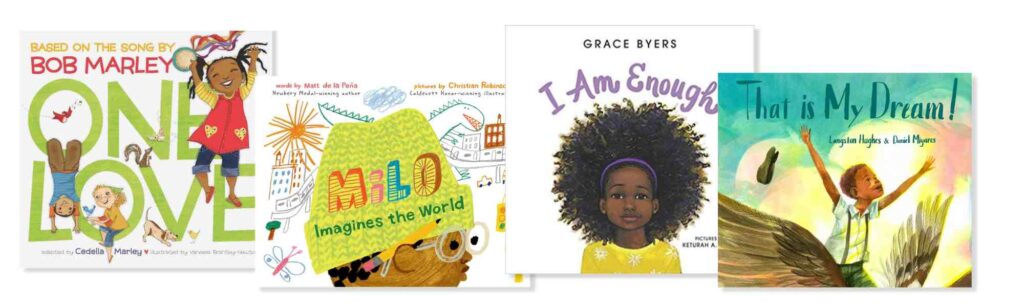
Four Must-Read Books for Children This Black History Month

Black History Month is an annual celebration of achievements by African Americans and a time for recognizing their central role in U.S. history. In our classrooms, students will learn about local and influential African Americans through engaging books, learning experiences, and thoughtful discussions.

Below are four age-appropriate books to read with your child to continue the celebration and conversation. These stories not only entertain, but also serve as windows into the diverse and inspiring narratives that make Black History Month a time of reflection, learning, and unity.

One Love by Cedella Marley (ages 1-3 years)

Adapted from Bob Marley’s hit song, One Love reimagines the iconic tune for a new generation of children. The book is filled with colorful pictures and introduces themes of unity, joy, and the beauty of coming together as one. One Love is more than a story; it’s a shared celebration of positivity and solidarity that will resonate with both you and your child. 

Milo Imagines the World by Matt de la Peña (ages 3+ years)

Milo Imagines the World tells the story of Milo who rides the subway with his sister and imagines a life beyond the train – a world filled with wonders and adventures. He uses his creativity and thinks about the lives of everyone he encounters, including a boy in a suit, a man doing crossword puzzles, and a woman wearing a wedding dress. Milo soon realizes that you can’t really know anyone just by looking at their face.

I Am Enough by Grace Byers (ages 3+ years)

This story celebrates the beauty of diversity and empowers children to embrace their individuality, build self-confidence, and recognize their worth. With an important message and vibrant illustrations, I Am Enough showcases the importance of navigating life’s ups and downs and trying again after failure. 

That is My Dream by Langston Hughes (ages 4+ years)That is My Dream is a picture book adaptation of Hughes’ acclaimed poem “Dream Variations”. It brings readers on a journey of one African American boy’s day, how he is treated differently, and his dream of a more united world. Through vivid illustrations and poetic storytelling, this book sparks meaningful discussions about equality, hope, and diversity. 

Bye-Bye Blues: Helping Your Child Overcome Separation Anxiety

Let’s resolve those drop off fears and tears as we chat with our Behavior Specialist Consultant, Amber Fine. Amber has spent the last decade in the mental health sector, in both public and private services, supporting children and their families. She is proficient in the area of Infant Mental Health and is a licensed psychotherapist in the state of Florida.  

Hi Amber! When does separation anxiety typically manifest in young children and what are some signs that families can look out for?

Amber: Separation anxiety is a developmentally appropriate behavior that can present itself around 6-8 months and typically peaks in toddlerhood. These behaviors can start to dissipate after 2 years but can ebb and flow depending on circumstances occurring in the child’s life. Any new transition may contribute to separation anxiety. We sometimes see behaviors such as difficulty separating from caregivers, difficulty with emotional regulation (which may present as crying, yelling, or emotional outbursts), excessive worry, disturbance in sleep routine, and somatic symptoms like stomach aches or nausea.

What are some strategies families can implement to help their child cope with separation anxiety when leaving for preschool? 

Amber: Strategies will differ for all children, depending on what brings them comfort. I think most importantly, the strategies used will carry themes of comfort, planning, and preparation. When children know what to expect, it can help them in preparing themselves. 

Make your child’s morning as comfortable as possible, prior to drop-off. This might entail eating breakfast together, listening to their favorite music, or talking about all the fun things you will do as a family later that night. 

If you’re preparing your child for a new environment, visit the school prior to the first day, with the child present, allowing them to meet their teacher and explore their new classroom. If the school allows, send a comfort item in with the child, which can allow for them to feel more connected to home. Partner with teachers and staff, educating them on what your child likes, doesn’t like, and what can help when your child is experiencing big emotions. If you have a positive and excited disposition and tell your child what a great day they are going to have, they will likely follow suit. 

How can families strike a balance between addressing their child’s separation anxiety and encouraging their independence?

Amber: You want to ensure you are acknowledging and validating your child’s feelings, while also projecting confidence and providing reassurance. Talking through the routine of the day, the people your child will interact with, and all the fun activities they are going to do can help to ease your child’s drop-off fears. Also, discuss with your child when they can expect someone to pick them up, who it will be, and ensure appropriate follow through.

Are there play or social activities that can aid in fostering a sense of independence and confidence?

Amber: Extracurricular activities are a great way to begin exposing children to peers, other adults, and expected social norms, while instilling a sense of independence and confidence. Some ideas include play dates, children’s fitness classes, intramural sports, and children’s classes at your local library. When your child is engaged in fun activities like these, they won’t even realize they are learning important social-emotional skills.

How can families manage their own feelings of guilt or worry when leaving their child who is experiencing separation anxiety?

Amber: Just as you would prepare your child, it’s equally important to prepare yourself for this new experience. Familiarize yourself with the staff at your child’s new school, understand their daily routine, and establish expectations for communication. Investing time in helping your child build connections with their new teacher, peers, and surroundings can significantly ease their worries, which will ultimately put the entire family more at ease.

Raising Thankful Kids: 5 Books to Instill Gratitude in Your Preschooler

Building a sense of gratitude in young children is an essential part of their development. Through our Links to Learning curriculum, we continuously strive to cultivate an environment where appreciation is nurtured all year round. As we approach this joyous holiday season, we are particularly reminded of the significance of fostering an attitude of gratitude in our students and incorporate hands-on lessons related to empathy, kindness, and giving back.

A great way to continue the learning at home is through meaningful conversations with your child. Consider asking questions such as, “What made you smile today?” or “What are some ways we can show our friend that we are thankful for them?” and “What are you thankful for today?”

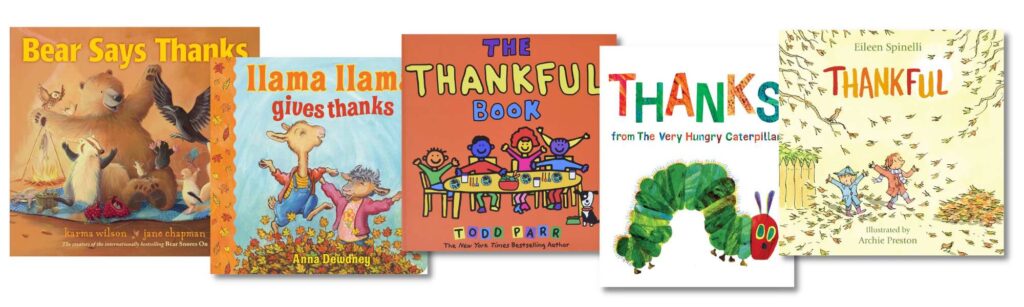
Books also provide an excellent platform for nurturing gratitude and inspiring discussions with your child. Take a look at some of our favorites below.

Bear Says Thanks by Karma Wilson

Your child will love the rhythmic text and engaging plot of Bear Says Thanks. Seamlessly weaving together the themes of sharing and thankfulness, this book follows Bear as he discovers the true meaning of gratitude. As Bear navigates his day, various situations prompt him to reflect on the significance of expressing appreciation for others. 

Llama Llama Gives Thanks by Anna Dewdney

If your child loves the Llama Llama books, this is a perfect story to read together this season. Llama Llama embarks on a journey to discover the true meaning of Thanksgiving, guided by the loving support of family and friends. The book encourages readers to embrace the spirit of gratitude during the holiday season and beyond.

The Thankful Book by Todd Parr
This enchanting book from Todd Parr not only fosters a sense of thankfulness, but also encourages children to embrace diversity and empathy. From the sunshine to our food, this story emphasizes the importance of acknowledging the wonderful things around us. It’s a timeless reminder to appreciate the little blessings that make life extraordinary.

Thanks From the Very Hungry Caterpillar by Eric Carle

Eric Carle’s iconic collage-style illustrations vividly capture the wonders of nature and the joy of friendship, inviting young readers to cherish the beauty of the world around them. Join the beloved Hungry Caterpillar as he encounters a host of animals, navigates the changing seasons, and learns to give thanks for the simple joys each moment brings. 

Thankful by Eileen Spinelli

Thankful beautifully highlights the importance of showing appreciation for the people who enrich our communities, from dedicated gardeners to selfless firefighters, whose contributions sometimes go unnoticed. With its charming rhyming text and whimsical illustrations, this book reminds us to cherish the small joys that fill our days. 

Little Hands, Big Hearts: Benefits of Teaching Children about Giving Back

The holiday season is not just about festive decorations and presents. It’s a time to reflect on the past year, learn about different traditions, and most importantly, instill a spirit of charity.

Giving back is an integral part of our school. Whether we’re collecting food, toys, gifts, or clothing… it’s amazing how much joy simple acts of kindness can bring. 

Here are just a few of the many lifelong benefits of involving children in giving initiatives. 

Develops a sense of community
Giving back to those in need instills a sense of communal responsibility and provides children with tangible examples of how their actions directly affect others. Making holiday cards, for example, becomes more than a craft; it becomes a heartfelt gesture to bring joy to neighbors who may feel isolated during the holiday season. Children learn that their contributions, no matter how small, are integral to the well-being of the larger community.

Fosters empathy and gratitude

Empathy and gratitude are paramount to social-emotional development. When students participate in giving initiatives, they begin to understand the needs of others and the importance of compassion and kindness.

This exposure in the preschool years sets the stage for a lifelong positive and appreciative mindset. 

Builds important life skills

Our students plan their community service events from brainstorm to implementation and learn valuable life skills, including teamwork, problem-solving, communication, and responsibility. These skills contribute to the development of well-rounded individuals. Not only are they academically prepared for what comes next, but they also exhibit social consciousness and work collaboratively to make a difference in their world. 

Encourages a sense of pride

Successfully completing a service project instills a sense of pride and self-esteem in our students. When they recognize that their contributions have left a positive impact, it boosts their confidence and reinforces the notion that their actions matter.

Exploring Centers: What They Are and Why Your Child Will Love Them

Have you heard the phrase ‘classroom centers,’ but have no idea what that refers to or how it helps your child’s development? If so, you’ve come to the right place.

We’re diving headfirst into all things centers with our Director of Educational Services, Erin Pastushok. With nearly three decades of experience in early childhood education, Erin has worn various hats, including that of a teacher, principal, and now director. She is a certified Infant, Toddler, and Family Specialist through the North Carolina Infant Toddler Program, as well as a certified Trainer through the Center on the Social and Emotional Foundations for Early Learning (CSEFEL). 

Q: Hi Erin! What are centers and what types are found in our classrooms?

Erin: Centers are defined areas of the classroom that allow for hands-on learning in smaller groups. Teachers purposefully group items and materials together in centers that encourage particular types of play based on the interests and skills of their students. Depending on the age of the children, our classroom centers include Construction, Dramatic Play​, Manipulatives​, Sensory, Art​, Writing, Science, Language and Literacy, and Music. Hands-on learning is one of the best ways to teach children, which is why centers are a hallmark of our Links to Learning curriculum. 

Q: How do centers contribute to a child’s learning and development?

Erin: A child’s impulse to ask questions, to investigate, and to explore comes from a burning curiosity about the world. Learning through hands-on play within centers allows children to make connections between abstract concepts and real-world experiences. It helps them build foundational skills, such as problem-solving, cooperation, communication, and self-regulation, all while having fun and staying motivated. Because of this, our students spend more than a third of their school day in centers!

Q: Can you share examples of how you’ve seen children make significant developmental strides in centers?
Erin: Centers are designed to provide holistic learning experiences that promote growth in all forms of development. I’ve seen students make large strides in their social-emotional development while exploring in centers. They develop cooperative play skills, such as taking turns and resolving conflicts using words. Center-based learning also fosters positive interactions between students and teachers. These social-emotional skills are all imperative for having positive interactions and relationships in the future. Through discussions in centers about feelings, students develop empathy and learn to manage their emotions. In terms of academic skills, I’ve seen students improve their addition skills by simply using materials that interest them; for example, building a tower in the Construction center and grouping and counting the blocks used. The possibilities are truly endless.

Q: It sounds like centers are very collaborative. How do teachers encourage problem-solving and teamwork with students who may be shy or timid?

Erin: That’s the beauty of centers. They give teachers the opportunity to personalize the learning for every child. Teachers provide open-ended materials, model problem solving, and encourage students to work together to achieve a common goal (i.e., building a structure with blocks, creating group artwork). Teachers also integrate real-life scenarios, such as setting up a restaurant where children take on different roles, collaborate to prepare meals, and solve problems related to customer service.

Q: How do teachers create a safe and supportive environment within centers?

Erin: Teachers prioritize safety in centers because we know that when children feel safe, they are more likely to take risks in their learning and collaborate more freely. Each of our classrooms have an established Center Management System at student eye level. This empowers students to navigate each center independently, choose materials, and engage with activities. A Center Management System might be a sign with Velcro pieces indicating the maximum number of students allowed at that center and photographs of each student with their name clearly labeled. When a child wants to use a center, they place their photo onto the center sign of their choice. When they want to leave the center, they put away the materials, remove their photo, and choose a new center.

Q: How do centers remain interesting to children over time?

Erin: Teachers rotate materials regularly to maintain their students’ interest. Think about how your child gets bored of their toys at home. If you put those toys away for a bit and bring them back out in a month or so, it’s like they are brand new all over again. We do the same in our classrooms. As I previously mentioned, we also include open-ended materials, such as blocks and objects from nature. These can be used in a variety of ways, encouraging students to use their imagination to create and explore. 

Q: To wrap up our conversation, what can families do to reinforce and complement the learning their child gains from participating in centers at school? 

Erin: Create a learning environment in your home by designating a safe, specific area stocked with age-appropriate books, educational toys, art supplies, and other materials that encourage exploration and creativity. Equip this space with hands-on activities like puzzles, building blocks, and simple science experiments, all designed to nurture problem-solving and fine motor skills. Within this environment, continue to have conversations with your child. Ask open-ended questions and encourage them to freely articulate their thoughts and feelings. This not only nurtures their language proficiency but also cultivates critical thinking. 

Navigating Your Child’s Big Emotions with Ease

The preschool years are a time of boundless energy, curious explorations, and the occasional emotional outbursts that may leave you feeling overwhelmed. Rest assured that you’re not alone. These sudden bursts of intense feelings from your child are a normal part of their developmental journey.

Think of your child as a young explorer who is embracing every opportunity to uncover the world around them. They’re on a quest to experience new things, but their emotional toolkit is still a work in progress. They might not have the communication skills necessary to express their thoughts and needs to you in a calm way. 

At our preschool, structure and routine are key to preventing emotional outbursts. Visual schedules are used in our classrooms, serving as reference for our students throughout the day. To ease transitions, our teachers incorporate intentional prompts, whether through a catchy song or chant – helping children prepare for what comes next. When our students exhibit desired behaviors, we celebrate them with praise.

However, outbursts do happen… and parenthood isn’t about perfection. It’s about growth, learning, and building strong emotional bonds with your child. Our teachers are your partners and are here to help navigate this journey with you. Below are some strategies we practice in the classroom that you can try at home.  

  1. Speak with a calm disposition.

Your child is likely to feed off your demeanor. When things get overwhelming, speaking in a calm tone can have a soothing effect, showing your child that you’re there to support and listen.

  1. Move your child to a safe place.

Safe spaces allow your child to regain their composure in an environment where they feel secure. For instance, if they’re having a meltdown in a busy store, walk with them to a quiet area. A change of scenery can provide a moment for your child to collect themselves away from loud crowds.

  1. Use calming techniques to help regulate emotions.

Help your child develop their own toolkit of calming techniques. Breathing exercises, counting to ten, or even imagining a happy place can be simple yet effective ways to regulate emotions.

  1. Offer connection or physical comfort.

Physical touch is a powerful way to communicate love and support. When your child is navigating a storm of feelings, a comforting hug can help them feel understood and cared for.

Model appropriate ways to express wants.

Although it may be difficult at times, do your best to express your own emotions, such as frustration and anger, in a positive way. When your child is struggling, you can remind them of your actions, and offer suggestions for ways they too can act appropriately. 

Math on the Move: Vacation Activities to Sharpen Early Math Skills

Summer is a wonderful time for children to discover the hidden mathematical wonders that surround them. In our classrooms, teachers aid in cultivating math skills by incorporating them into daily routines and engaging activities. They encourage students to observe and discuss patterns found on the playground, graph their favorite vacation spots, and participate in math scavenger hunts.

This summer, as you embark on vacations or road trips, you can continue supporting your child’s math skills by turning these experiences into fun and educational opportunities. Below are some ideas. Get ready to go on a mathematical adventure together! 

Infants (0-1 year)

Engage your baby in an activity that combines sensory exploration and counting. While at the beach, encourage them to feel the texture of the sand by saying, “Let’s feel the sand. It’s so soft and grainy.” Incorporate counting by finding seashells. Count them aloud by saying, “Let’s see how many seashells we found. One, two, three!”

Toddlers (1-2 years)

Roll or throw a ball back and forth with your toddler. Count each time the ball leaves their hands. Begin with counting from one to three, and gradually increase the count as your child becomes more comfortable. Encourage them to actively say the numbers aloud as they catch and throw the ball. 

Beginners (2-3 years)

Play a game of “I Spy” on your next road trip to help your child observe patterns and practice their observation skills. Encourage them to point out objects found during the drive. For example, ask them to find a red and black car, a tall green tree, and a yellow sign. 

Intermediates (3-4 years)

Take your child on a nature walk to collect materials such as leaves, sticks, and rocks. Encourage your child to sort the materials into different categories and then count each item in each category. Record the findings in a bar graph to determine which material was the most and least collected.

Pre-K/Pre-K 2 (4-5 years)

While shopping for your vacation essentials, give your child coupons and ask them to help you find the pictured items in the store. It’s a fun scavenger hunt, as well as a great opportunity for you to talk about money. Say the price of the items as you place them into your cart, for example, “Goggles are usually $10 each, but we save $2 by using a coupon.”

Thriving Through Play: Gross-Motor Activities for Growing Preschoolers

Children grow tremendously from birth through age five, so it is vital that we are there to support them. At our preschool, we help children with balancing skills, hand-eye coordination, and how to stay healthy and safe. It’s all part of our comprehensive Links to Learning curriculum, designed to help every child thrive.

Our dedicated teachers promote wellness through daily learning experiences that encourage children to climb, run, hop, dance, and practice rhythmic movement. Games like Freeze Tag, Simon Says, and Red Light/Green Light help children develop gross motor skills while having a blast! 

It’s not all about physical play – we know the importance of building social-emotional skills too. Following directions, teamwork, and taking turns are all part of the fun during our activities. Plus, we also introduce children to basic nutritional and safety concepts, setting them up for a lifetime of healthy choices.

Below, we have compiled a list of age-appropriate outdoor activities that you can do with your child to help continue the development at home. 

  1. Infants (0 – 1 year)

Grass provides a natural and forgiving environment for your infant to explore safely. Take your baby outdoors and allow them to practice movement and balance. Place rattles, soft balls, or textured toys a few feet from your infant, and encourage them to reach and grasp the items. 

  1. Toddlers (1 – 2 years)

Grab a bunch of colorful balls and head outside. Encourage your toddler to roll or kick the balls on various surfaces like soft grass, squishy sand, or smooth pavement. Watch their eyes light up as they discover the different textures and improve their coordination along the way. 

  1. Beginners (2 – 3 years)

Place a few hula hoops on the ground for a series of exciting jumping games. Ask your child to jump from one hoop to the next using both feet. Then, ask them to hop from one to the next on one foot. Lastly, challenge your child to hop from hoop to hoop alternating between their left and right foot. 

  1. Intermediates (3 – 4 years)

Provide your child the opportunity to demonstrate smooth body control through different yoga poses. Lay out a mat, and introduce poses named after animals they are familiar with, such as cat, cow, dog, and frog. Perform the pose first and encourage your child to mimic what they see.

  1. Pre-K / Pre-K 2 (4 – 5 years)

Use chalk to write various numbers and letters in your driveway. Ask your child to perform a variety of movement by saying phrases such as, “Bear crawl to the letter K” or “Tiptoe to the number 5.” This activity not only fosters gross motor skills, but also encourages letter and number recognition and following directions.

Splash-tastic Adventures: Multi-Sensory Water Activities for Preschoolers

From splashing in puddles to playing with water toys, children love exploring the world of water. It may get messy, but the benefits are worth it. Water play serves as an excellent tool for promoting fine motor skills, hand-eye coordination, and sensory awareness, as well as opportunities for social interaction, taking turns, and sharing materials.  

Our teachers leverage the fun of water to reinforce a variety of skills. For instance, students explore the science of melting ice cubes in the warm sunshine. We engage them in critical thinking by asking questions like, “What do you think will happen when we put the ice cube in the sun?” or “How long do you think it will take for the ice cube to melt?” Then, we discuss the results and encourage the students to reflect on the properties of water and the effects of temperature.

In addition to exploring the science of melting ice, we offer opportunities for students to engage in activities that tap into their desire to imitate grown-up tasks. For example, teachers may encourage them to participate in an interactive toy car wash using a bucket of soapy water, toy cars, and a clean towel to dry. This activity reinforces fine motor skills, while instilling a sense of responsibility and independence. 

Continue the learning at home with these fun water activities that can be customized for children of any age. 

1. Water Obstacle Course

Set up an obstacle course in your backyard or a safe outdoor area using different water play stations. Include activities like crawling under a sprinkler, tossing water balloons into a bucket, and stepping over shallow trays of water. This activity promotes gross motor skills, coordination, and following instructions.

2. Ice Excavation

Freeze small toys or figurines in ice using plastic containers or ice cube trays. Once frozen, place the ice blocks in a large tray. Equip your child with tools like spray bottles filled with warm water, spoons, or toy hammers to melt and excavate the toys from the ice. This engaging activity encourages your child to apply problem-solving skills as they discover new ways to release their frozen treasures. 

3. Floating Boats

Foster creativity and engineering skills while experimenting with buoyancy this summer. Challenge your child to design and build their own boats using materials like foam sheets, plastic containers, popsicle sticks, and tape. Once their boats are complete, provide a small tray or inflatable pool filled with water for a boat race. Encourage your child to use straws to create wind to make their boat move across the water. 

4. Water Painting

Looking for a mess-free art activity this summer? Provide your child with large paintbrushes and a bucket of water. Go outside and let them “paint” on a sidewalk or fence using the water. Watch as their art creations appear and then disappear in the heat. 

  • Employer Partnerships
  • Blog
  • Careers
  • Privacy Policy
  • CA Privacy
  • Terms of Use
  • Sitemap

©2026 All Rights Reserved Spring Education Group

Headquartered in Campbell, California, Spring Education Group is majority-owned by investment funds administered by Primavera Holdings Limited, an investment firm owned by Chinese persons and principally based in Hong Kong with operations in the United States, China and Singapore.

Follow Us:
youtube facebook instagram
Contact Us